
Overview
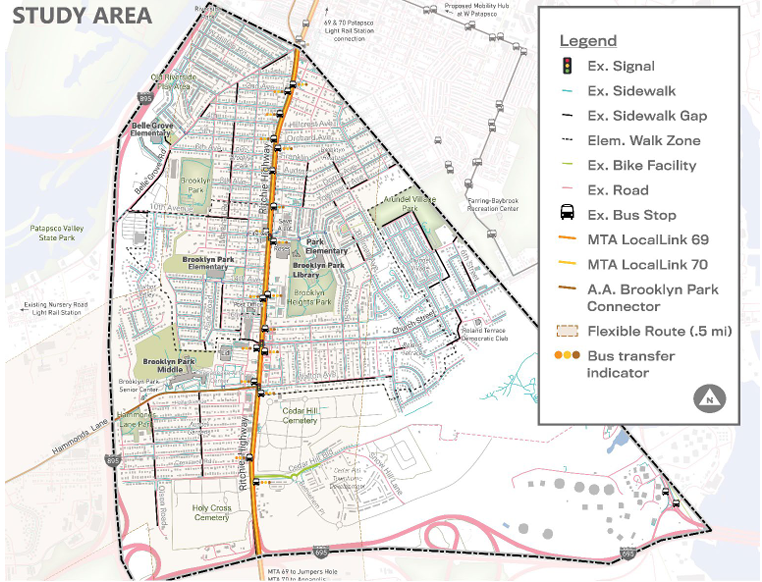
To analyze mobility in the Brooklyn Park neighborhoods, the Office of Transportation conducted The Brooklyn Park Neighborhood Transportation Study, also known as the Brooklyn Park Mobility Study (BPMS). The BPMS was the first mobility-focused study centering on the neighborhood of Brooklyn Park. The neighborhood and the Anne Arundel County Office of Transportation requested funding for this plan in 2021 with the goal of developing focused recommendations to improve the health and well-being of Brooklyn Park residents through mobility improvements. A major driver for this work was the identification of Brooklyn Park as one of the neighborhoods in Anne Arundel County where the social determinants of public health are significantly worse than neighboring areas in the county. In the study, “mobility” refers to the physical ability for people in Brooklyn Park to move around to access their daily needs, jobs, family, and recreation by walking, biking, taking public transit, and driving. The study included research into the existing multimodal network, traffic and parking, and other elements of the transportation system. It also includes a summary of the public outreach, complete mobility recommendations, programming and policy recommendations, and a prioritized list of projects.
Brooklyn Park Neighborhood Transportation Study
Sub-Projects
Priority Project #1
This project is developing a Vision Plan for Ritchie Hwy for all of the roadway through Brooklyn Park. The project also performed traffic calming analysis on Olson Rd, Church Street, and Hammonds Lane.
Priority Project #3
Priority Project #3 from the Brooklyn Park Study, funded by the Baltimore Metropolitan Council's (BMC) Transportation and Land Use Connections (TLC) Grant Program, is currently underway and is performing a feasibility study for bicycle facilities on 10th Ave., Morgan Rd., and Ballman Ave.
A public meeting was held May 6, 2026 at the Brooklyn Park Library. The presentation can be viewed here.
Priority Project #4
This project, also funded by the BMC TLC Grant Program, developed 30% design plans for the pedestrian connections suggested in Priority Project #4 from the BPMS.
- Public Meeting #1 Materials
- Public Meeting #2
- To Introduce 30% (Preliminary) Design - June 3, 2025, 6 - 7 pm, Brooklyn Park Library
- View the 30% design plans