
A Vegetation Management Plan (VMP) is used for minor forestry related maintenance and management involving less than 5,000 square feet of canopy and/or vegetation.
Habitat Enhancement Plan (HEP) may be used in managing existing forest or other natural areas to enhance the habitat and ecological balance involving areas up to an acre. Activities may include pruning for health and safety of vegetation, non-commercial timber stand improvement, and eradication of non-native invasive vegetation and planting of native species in those areas.
A Standard Grading Plan (SGP) is a plan that may be used in lieu of a Grading Permit for certain minor grading and earth disturbance associated with commercial and residential construction, and, if necessary, may be required to include sediment and erosion control plans.
Please see the attached chart for permitting guidance for clearing, grading and pruning Tree Pruning and Grading Chart.
No, the VMP and HEP do not have an application fee. The Standard Grading Plan does have an application fee of $75.
VMP information can be found on the county website /inspections-and-permits/forestry/vegetation-management-plans/inspections-and-permits/forestry/vegetation-management-plans
HEP application information can be found here https://drive.google.com/open?id=1mHgtC_6sZh9rfSNOglo19Gs6PhvrDAX0&usp=drive_fs
SGP application information can be found https://www.aacounty.org/inspections-and-permits/code-compliance/standard-grading-plan
Please contact the Anne Arundel County Department of Inspections and Permits Forestry Program at: 410-222-7441 or forestry@aacounty.org
Please see the attached chart
No. Maintenance of an existing turf lawn in the Critical Area Buffer is not clearing and does not require a permit. Once an area of lawn in the Buffer naturally regenerates into forest or woody vegetation, it will require review and approval to clear or mow.
No. The VMP can only approve the cutting of vegetation with no soil disturbance. Please see the forestry website for more information.
Yes, if it is a part of a forestry habitat restoration and enhancement project approved by the county. Erosion and Sediment controls shall need to be installed and maintained as approved and required by the county inspector.
For projects less than 5,000 square feet that require grubbing of roots, please see: Standard Grading Plans | Anne Arundel County Government
No. The Habitat Enhancement Plan is only for the restoration and enhancement of natural areas, and not for clearing and conversion to another use, i.e. lawn.
A sound and solid implementable plan will be necessary for the success of an HEP. Generally, experienced Community volunteers and Licensed Tree Experts may have sufficient practical experience to write a sound plan for simple projects such as vine eradication and community wide pruning. Complex invasive plant eradication efforts or non-commercial timber stand improvement projects will require greater detail in the plan. Applicants can look to the knowledge and experience held by design professionals such as Landscape Architects and Licensed Foresters for this greater detail.
Depending on the scope of the project, detailed information regarding the identification of invasives, removal of them, sequencing of work, reforestation/replanting with native species , diagrams/plans are needed. For assistance with these applications, we recommend reaching out to a local non-profit, natural resource consultant, landscape architect, FCA Qualified Professional, or Maryland Registered Professional Forester.
Generally invasive plants often require multiple applications of an herbicide or multiple cuttings to ensure 100% eradication. The plan should include a timeline indicating the total time expected to completely eradicate the invasive plants, including proposed scheduling. In some instances, grubbing of roots may also be required. Erosion and Sediment controls are required and maintained.
A management plan to ensure maintenance and management of areas (short term and long term) is required. This is critical to growth of native vegetation, eradication and management of invasives, overall health of the forests and project success.
The American National Standards Institute (ANSI) is a private, non-profit organization that administers and coordinates the U.S. voluntary standards and conformity assessment system for arboriculture.
The A300 Standards were developed by a committee of professionals in the field of arboriculture to provide a uniform level of service and to help ensure public safety.
Copies of ANSI A300 are available to view at the County Forestry office. Please make an appointment to view the documents by calling 410-222-7441 or by email forestry@aacounty.org. The standard is also available for purchase through the International Society of Arboriculture at https://www.isa-arbor.com
The American National Standards Institute (ANSI) defines pruning as the “selective removal of plant parts to meet specific goals and objectives”.
Pruning can be performed to improve the health of the tree/shrub, to remove dead branches, to reduce potential hazard to structures, and for aesthetic purposes.
Pruning must be done per ANSI A300 standards - see attached information sheet
TreesAreGood_Pruning Young Trees_0621.pdf
Refer to this bulletin for standards and best practices https://drive.google.com/file/d/1VhSFbpPfFyOYgdgxGzrHKDvy6DPxTYXO/view?usp=sharing
Please see the attached chart
For more information, Please contact the Anne Arundel County Department of Inspections and Permits Forestry Program at: 410-222-7441 or forestry@aacounty.org.
Topping is a harmful tree pruning practice which can increase the risk of tree failure and other hazards. Topping can remove more than 50% of a tree’s nutrient producing leaves, which forces rapid growth of multiple shoots, stresses the tree, and makes the open wounds more vulnerable to decay, disease and insect infestation. The new shoots grow quickly and are weakly attached in the outermost layers of the parent branches, making them more prone to breaking. Trees that have been topped for many years form a thick layer of shoot growth at the topping cut that shades the soil preventing the natural growth of understory trees and shrubs. This bare soil erodes during rain events, damaging the slope and all beneath it.
Here are some informational documents that provide further information on this topic.
https://treesvirginia.org/images/pdfs/2023-trees-virginia-tree-topping-brochure.pdf
https://drive.google.com/file/d/1CUaZMO2jNUwuoA7Dc1iFCEbA5TLl7YVi/view?usp=sharing
https://drive.google.com/file/d/1CNeXKLteQW6-H9ot20i9R1Xh8X3EeBC5/view?usp=sharing
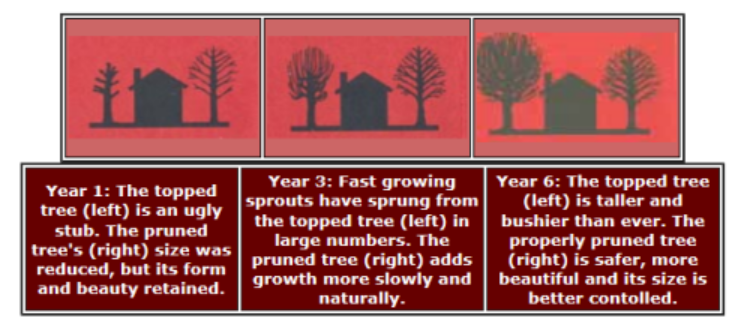
Reference - Illinois Department of Natural Resources
Topping: cuts are made indiscriminately on a branch without regard for tree health or structural integrity using “heading” cuts (cuts that are made between branches, leaving a stub).
Pollarding: A semiformal pruning system that maintains crown size by initial heading of branches on young trees or young portions of older trees, followed by removal of sprouts to their point of origin at appropriate intervals without disturbing the resulting pollard head. The main difference with pollarding is in maintenance. A true pollard involves cutting the shoots that result from an original header cut back to a branch knuckle (original callus knob).
Refer to the following documents published by Maryland Department of Natural Resources (MDDNR) Forest Services. Good Green is a MDDNR Maryland Department of Natural Resources Forest Service initiative to protect native vegetation in our natural areas. The initiative was started as a Landscape Scale Restoration grant from the U.S. Forest Service.
Homeowner's Guide to Managing Invasive Plants https://drive.google.com/file/d/1zksskFDXrMQXBZu0fDIB9EUkT6ulzDl6/view?usp=sharing
Land Manager's Guide for managing invasive plants https://drive.google.com/file/d/1_pCnNdTWiS1_wGxUEYpG7Wyu4TMcxqQD/view?usp=sharing