
Background
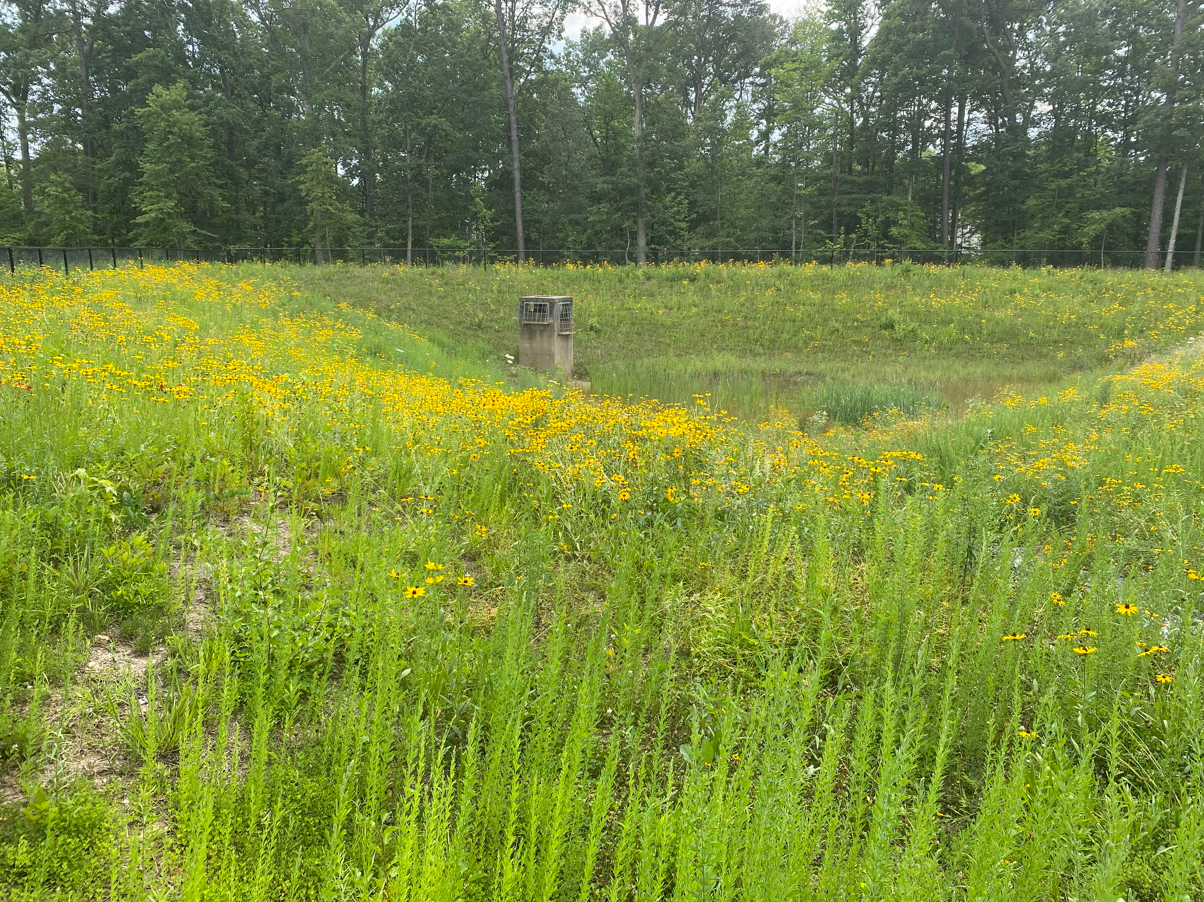
Anne Arundel County manages hundreds of stormwater ponds designed to control flooding, process nutrients, and trap sediment. Traditionally, these ponds are vegetated with turf grass and mowed frequently from fenceline to water’s edge.. While functional for drainage, turf grass offers minimal ecological value, requires continual maintenance, and is prone to grazing by geese (leading to erosion of slopes).
In contrast to managed turf grass, native Maryland wildflowers and grasses - such as Common Milkweed (Asclepias syriaca) Milkweed), Switchgrass (Panicum virgatum) and Little Bluestem (Schizachyrium scoparium) - have robust root systems that grow several feet deep, which offer the following benefits
- Increased soil infiltration
- Increased soil stabilization and reduced erosion
- Increased carbon storage
- Increased uptake and processing of pollutants such as nitrogen (N) and phosphorus (P)
The “No Mow” stormwater pond initiative was originally conceived as a strategy to reduce bacteria inputs to stormwater ponds by deterring Canada goose congregation (existing research has shown that meadow-like buffers are an effective method of passive goose control). Further literature review revealed the potential of buffers to reduce inputs of other pollutants, prevent slope erosion, and result in an “ecological uplift” in and around the pond..
If this work shows that vegetative buffers effectively N, P, and suspended sediment (TSS) concentrations in pond waters, and result in ecological uplift (as measured by bird, insect, and amphibian species diversity), it could result in buffers becoming standard practice at many other County stormwater ponds.
Research Study
Goals: The goal of the “No Mow” stormwater pond study is to determine if biological uplift and water quality improvement can be achieved by transitioning the zone around traditional stormwater ponds into native meadow habitats. Specifically, the study assesses:
- Pollutant reduction: Can vegetative buffers improve water quality by reducing nitrogen, phosphorus, and sediment levels in ponds before they enter receiving surface waters?
- Ecological “Uplift”: Does the addition of native plants increase the diversity and abundance of insects, birds, and amphibians utilizing the pond area?
- Maintenance efficiency: How does "No Mow" management impact long-term county maintenance costs and pollution emissions?
Sampling Protocol: Fourteen ponds - seven experimental and seven control - throughout the County were selected for the “No Mow” study. The ponds are visited bi-weekly (once every two weeks), and water samples are taken for N, P, and TSS analysis. During each visit, a water quality sonde is also used to obtain temperature, pH, dissolved oxygen, and specific conductivity measurements. In addition, the number of Canada geese and other waterfowl present within the pond enclosure are recorded during each visit.
Project Status: Pre-implementation monitoring was conducted for 24 months beginning in April 2024 and ending in March 2026. In Spring 2026, vegetative buffers consisting of native grasses, forbs, and wildflowers, were installed at the seven experimental ponds. Despite being referred to as “no mow,” these buffer areas will actually be mowed once or twice per year in order to deter vines, trees/shrubs, and other desirable vegetation from becoming established. The seven control ponds received no buffer and maintenance will continue as usual. After one growing season, water quality monitoring will continue at all 14 ponds for another 24 months.
Contact Us
If you have questions about a specific pond in your neighborhood or want to learn more about the research methodology, please reach out.
- Project Lead: Mr. Douglas Griffith, Planner II
- Email: pwgrif04@aacounty.org
- Phone: (410) 222-1071
- Office: Anne Arundel County Department of Public Works Bureau of Watershed Protection & Restoration