Moving Forward: Moratorium Lifted
The lifting of the Baltimore City Sewer Service Area moratorium is the result of strategic partnerships and proactive infrastructure management. To address the initial capacity concerns, Anne Arundel County partnered with the Maryland Aviation Administration (MAA) to borrow unused wastewater capacity from BWI Airport, while the Maryland Department of the Environment confirmed that actual, lower peak flow data could be used to unlock additional capacity.
Looking ahead, County Executive Pittman has committed nearly $60 million in the FY27 budget to divert wastewater flow to Anne Arundel County-owned facilities—a plan finalizing in November 2026 with construction wrapping up in four to five years. Combined with ongoing upgrades to the Linthicum/Shipley Pumping Station, developer-led peak storage solutions, and localized flow optimizations, these efforts allow the county to lift the moratorium while providing the long-term infrastructure needs to protect our environment and keep up with economic growth.
General Overview
It was a temporary pause on all new construction projects and land use approvals, specifically within the Baltimore City Sewer Service Area (SSA).
Anne Arundel County’s Baltimore City Sewer Service Area (SSA) encompasses the area within Anne Arundel County that is served by Baltimore City’s Patapsco Wastewater Treatment Plant. This SSA includes areas in Anne Arundel County that drain into Howard County, Baltimore County, and Baltimore City. The boundary of the moratorium included only those areas within the Baltimore City SSA that drain into Howard County and Baltimore County and ultimately to Baltimore County’s Patapsco Sewer Pump Station. The part of the SSA that drains directly into Baltimore City was not part of the moratorium.
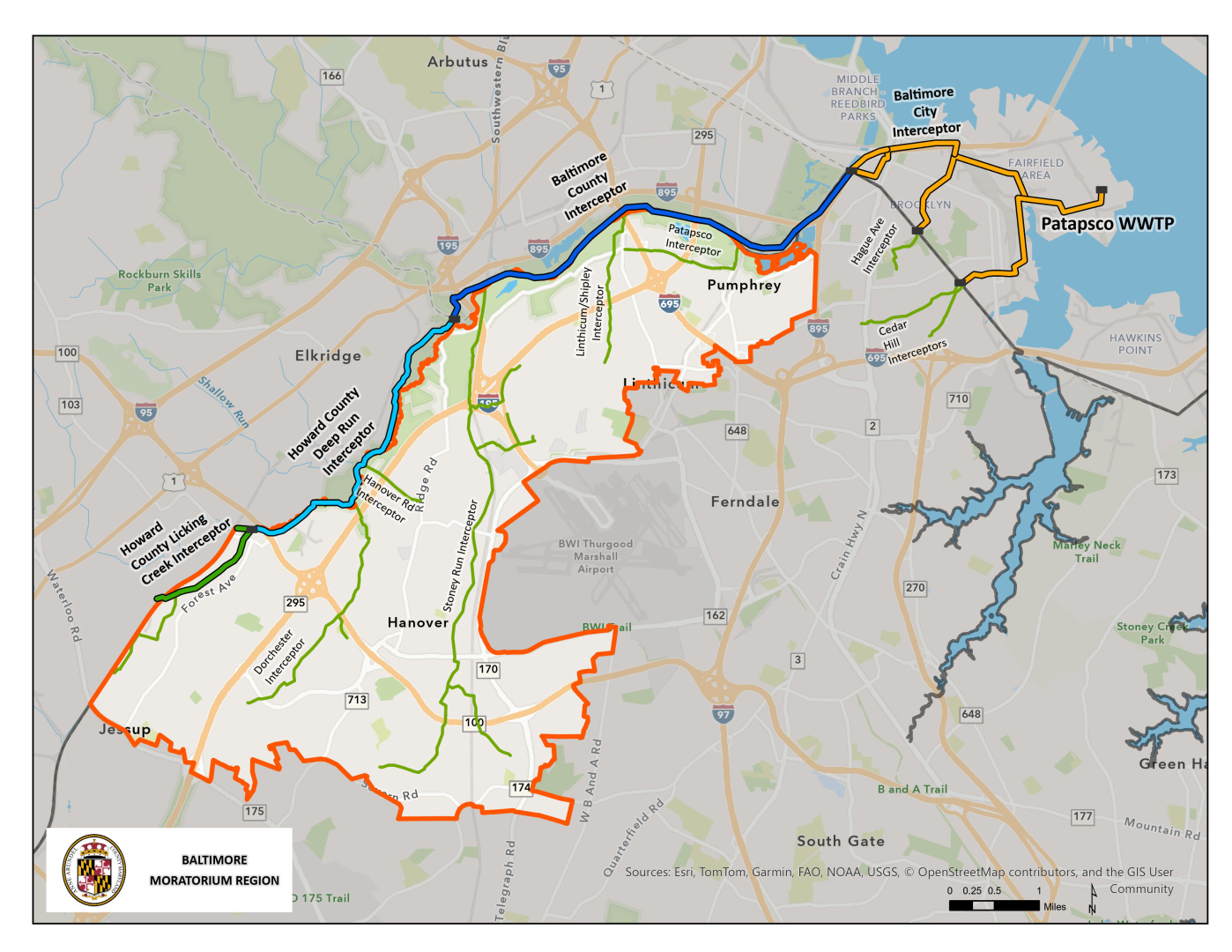
The primary goal was to prevent overburdening existing water and sewer infrastructure, which ensures the long-term sustainability of the system and protects public health and safety.
The moratorium was declared via a formal press release and an "Orange Notice" posted on the Department of Public Works (DPW) website.
The moratorium took effect on March 2, 2026 and was lifted on June 3, 2026.
Causes & Background
The discovery followed a methodology shift. Historically, capacity was modeled using Average Daily Flow (ADF). However, an internal audit required a shift to Peak Flow metrics to comply with regional Consent Decrees and a 1976 Interjurisdictional Agreement.
Under these stricter Peak Flow parameters, several connection points to Baltimore County were identified as operating at their maximum agreed-upon peak capacity.
The system relies on complex, 50-year-old agreements between Anne Arundel, Baltimore, and Howard Counties. All wastewater flow in this network ultimately moves to the Baltimore City Patapsco Wastewater Treatment Plant.
Understanding the Impacts
Any residential, commercial, or industrial development that didn’t hold a formal allocation was temporarily suspended.
Yes. The following were allowed to move forward:
- Tenant fit-out permits that require no additional sewer capacity.
- Residential properties with failing septic systems that needed to connect to the public system.
By limiting new flow, we reduced the risk of Sanitary Sewer Overflows (SSOs) and hazardous basement backups.