
Background
The proper design and construction of an engineered Stormwater Best Management Practice (BMP) is essential to its ability to detain runoff and adequately remove pollutants from the stormwater. Equally important is the proper operation and upkeep of such a facility. Proper maintenance will not only increase the expected lifespan of the facility, but will also improve aesthetics and property value. Most maintenance problems with BMPs are less costly to correct when they are caught early – as the old adage goes, “an ounce of prevention is worth a pound of cure.” Regular inspection and maintenance is an ongoing legal requirement.
Over the past 2-years, the Department of Inspections and Permits (Department) staff met with various representatives from the Development community which includes design professionals, contractors, developers, Homeowner’s association (HOAs), and county agencies to discuss on-going issues with the design, construction and maintenance of stormwater BMPs. One piece of feedback the County received from various representatives is that the BMPs are expensive to maintain and maintenance is an afterthought in the review & design process.
Purpose
The Purpose of this notice is to provide guidance on BMP design and maintenance i.e., designing for maintenance. The County recognizes that BMPs are designed, reviewed and approved based on many factors including but not limited to site conditions, Watershed conditions, Terrain, Stormwater Treatment Suitability, and Physical Feasibility – this guidance is not intended to cover each and every design scenario or site condition the design professional may encounter in the design of BMPs.
BMP Design and Maintenance
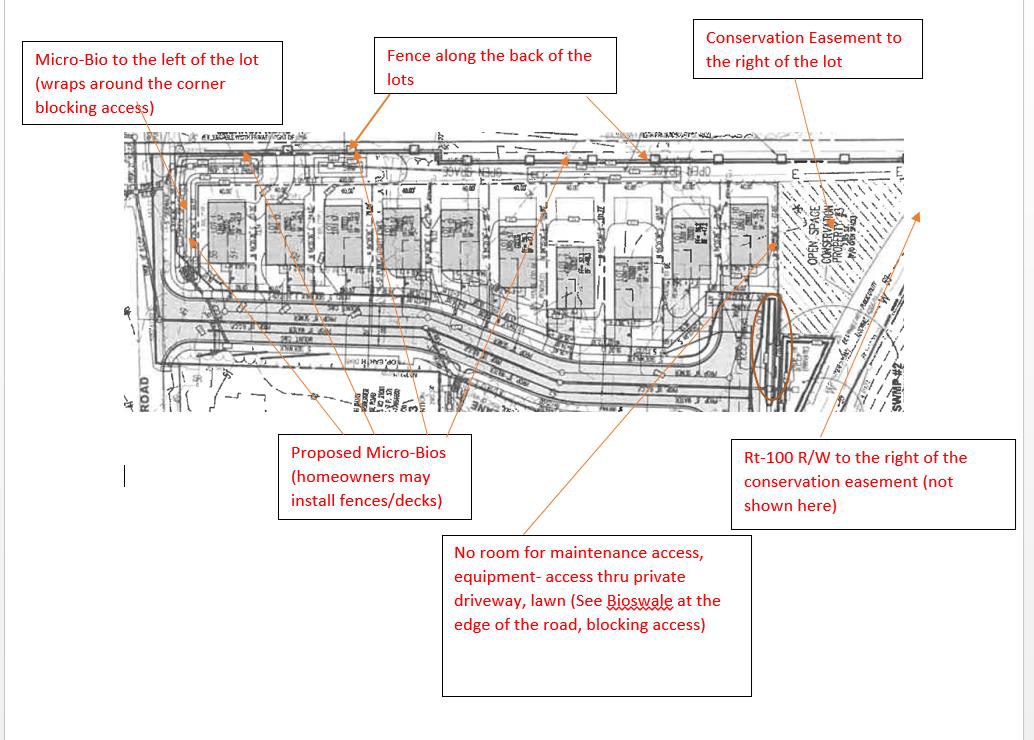
BMPs must have dedicated maintenance access for the maintenance personnel and equipment to be able to access and maintain BMPs. The BMP location and configuration of access must be established during the design phase and should be an integral part of the BMP design. BMPs designs should also consider that BMPs may fail due to a host of reasons, and that the owners could be required to replace, repair or retrofit them to meet county requirements. In the below schematic the micro-practices proposed behind the lots do not have adequate access to be able to perform maintenance or reconstruct/repair in case of failure. In this example, BMPs are not designed for maintenance.
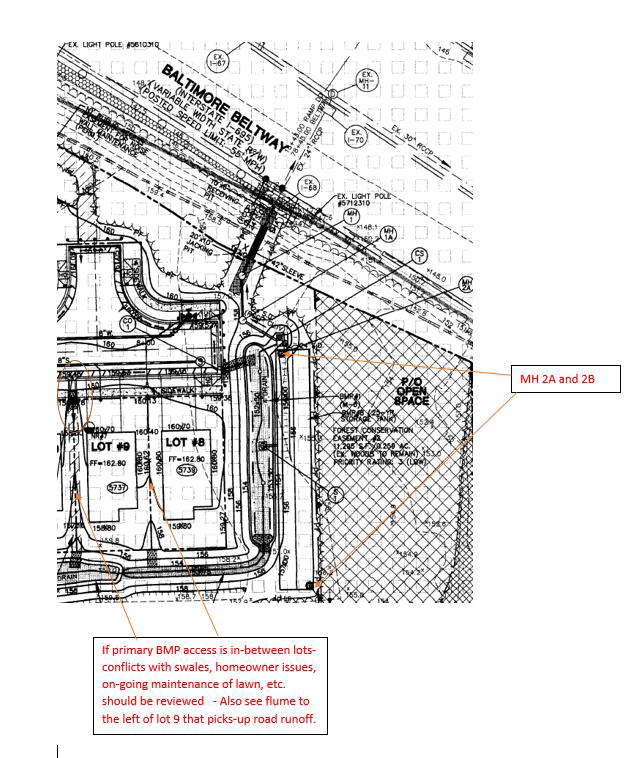
In the below schematic, the Underground detention facility (storage tank) is “sandwiched” between micropractice and conservation easement and does not have not have adequate access adequate access to be able to perform maintenance or reconstruct/repair in case of failure. Notice the Manhole structures 2A and 2B – it is very difficult if not impossible for a HOA to maintain, vacuum (the vac truck hose will need to cross lot, MicroBio ) these manholes for both routine and non-routine maintenance. If the Underground facility needs repair or reconstruction in case of failure, it will be a significant expense to the HOA. In this example, BMPs are not designed for maintenance.
BMP Access – Routine and Non-Routine Maintenance
All BMPs require two basic types of maintenance: (1) routine maintenance and (2) non-routine maintenance (e.g., emergency maintenance). The below is not intended to cover each and every design scenario but is rather intended to provide guidance regarding BMP design and maintenance (this guidance is primarily geared towards BMPs in residential projects but all BMPs- residential and non-residential shall be designed for maintenance).
- Access and maintenance must be designed and built with a concept of the maintenance tasks that may be needed. Consideration shall be given to providing additional distance around the BMP to provide enough room to complete maintenance tasks and facility reconstruction/repair in the event of failure;
- Access widths for a typical microscale practice may be 8-ft but may vary depending on the type of BMP, maintenance tasks, equipment, location, etc. An easement is not required when this access is already an open space.
- Designers shall consider the type of equipment (wheelbarrows, hand equipment, pick-up truck, dump truck, vac truck, etc.) required to perform required maintenance tasks and facility reconstruction/repair in the event of failure;
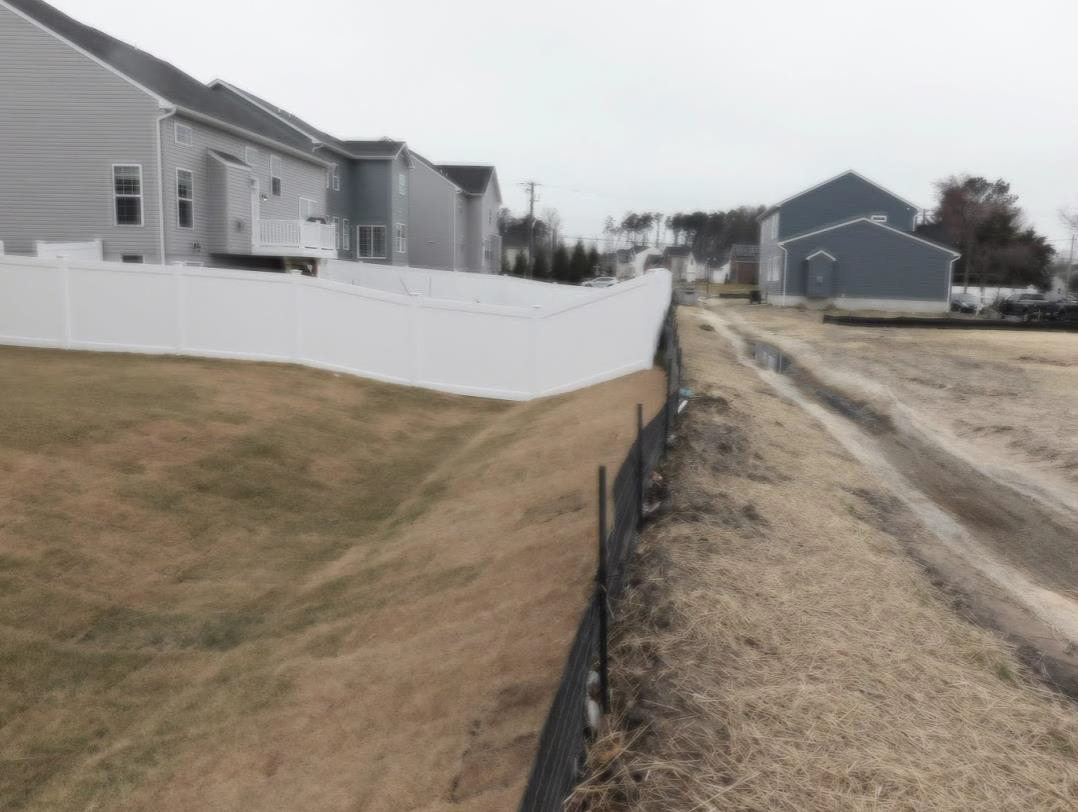
Designer should be consider practical and homeowner conflicts (e.g., fencing, decks, and privacy issues) – see below schematic of homeowner installed fence blocking the entire Bio-swale, which is still under construction. Note that homeowners install fences, decks once they move in, years after project approval;
- Designers should consider BMP maintenance costs, life cycle costs and budgetary and administrative issues in the design. For example, underground detention facilities & structures, proprietary practices, should only be proposed as a last resort in residential projects, where HOAs are not typically equipped to handle maintenance issues and potential replacement, repair costs. Designers should also consider the old adage “out of sight, out of mind” as homeowners/HOAs may forget BMPs that are not readily visible;
- Where BMPs cross multiple lots, BMPs should be placed in an easement or on open space to ensure that BMPs are protected against encroachments, blocking, etc.;
- Where Swales convey runoff across multiple lots, cross multiple lots (2 or more lots or greater than 2-cfs in 10-yr event), these conveyances should be in an easement or on open space;
- Operation and Maintenance (O&M) plan should be included as a part of every stormwater BMP design. O&M guidance should list specific inspection and maintenance activities required to ensure the proper functioning and upkeep of a particular BMP;
- The Department is currently working with stakeholders as a part of Stormwater Workgroup on issues related to design, construction and maintenance of stormwater BMPs. The Department plans to implement a BMP Hand-off meeting, which is a meeting between the developments Homeowner Association (HOA), the Developer and County staff. This meeting occurs after construction of the BMP’s and approval of the BMP as-built drawings; and
- Designers should also review Blue Notice IP-21-02 - Vegetation and Mulch in Stormwater BMPs
Timing
This memo is effective immediately. I&P has coordinated with the development community regarding this notice and I&P appreciates the collaborative effort to ensure BMPs are designed for maintenance.