
Background
The County recognizes that vegetation and mulch plays a significant role in the function of stormwater BMPs, and that it is an essential part of stormwater BMPs. The mulch layer provides important function in the stormwater BMPs as it provides filtration as well as an environment conducive to the growth of microorganisms that degrade hydrocarbons and organic material. Over the past 2-years, the Department of Inspections and Permits (Department) staff met with various representatives from the development community which includes design professionals, contractors, developers, Homeowner’s Associations (HOAs), and County agencies to discuss on-going issues with the design, construction and maintenance of stormwater BMPs. One feedback the County received from various representatives is that the mulch used in stormwater BMPs is expensive to maintain and prone to floating.
Purpose
The Purpose of this Notice is to provide guidance on plantings and the use of alternatives to mulch in stormwater BMPs. County recognizes that BMPs shall be designed, reviewed and approved based on many factors including but not limited to site conditions, watershed conditions, terrain, stormwater treatment suitability, and physical feasibility. This guidance is not intended to cover each and every design scenario or site condition the design professional may encounter in the design of BMPs nor provide blanket approval for vegetative and mulch alternatives without prior County review and approval.
Mulch in Stormwater BMPs
To prevent mulch migration or “floating mulch”:
- Mulch should be double or triple shredded hardwood because the shape (thin, fine, and stringy) binds more tightly and resists floating. Mulch should be wetted thoroughly via irrigation when installed.
- Mulch must be well aged, for a minimum of twelve months and spread over the entire surface area of the practice.
- Finely shredded mulch should be avoided as it may form a compacted surface over time because its shape tends to form interlocking pieces.
- Designers may review alternatives to mulch that are suitable to the site and meet project design requirements and site conditions.
- Where mulch is proposed in bio-swales and swales, it should be carefully reviewed against longitudinal slopes, velocities and design flows.
- Where Bioswales or grass swales ponding depth is used for ESDv or WQ credit, check dams shall be provided to ensure uniform ponding depth and treatment along the entire length of the swale. The placement of check dams should be reviewed against longitudinal slope, flows and velocities.
Alternatives to Mulch
The below is not intended to cover each and every design scenario but is rather intended to provide guidance on alternatives to mulch in the design of BMPs. The use of mulch alternatives is subject to the County’s review and approval.
- Stone is acceptable to use as an alternative to prevent floating mulch. Stone should be light in color to maintain cooler water temperatures and avoid damaging any shallow roots. Stone should never be used, regardless of color, in more temperature sensitive class III and IV watersheds because of its potential to raise water temperature. Stone may be angular in shape to provide extra resistance to movement, e.g., on slopes.
- Designers should consider the type/classification of stone that does not lend itself to leach substances that may be harmful to aquatic life.
- Designers may consider using low growing vegetation as an alternative ground cover to mulch, such as grasses, evergreens, ferns, or succulents, as growing conditions allow. A “managed turf grass” look should be avoided.
- Seed areas around plantings with a low ground cover seed (such as sedge, switchgrass, or juncus depending on type of facility) that will work with the plantings. The seed should be a single species to provide uniformity and make it easy to know plant from weed.
- Plant cover reduces water velocity and helps to anchor mulch in place. Plants may also be preferable to mulch since organic mulch may be a source of nitrogen or phosphorus. Designers may consider adding an understory of vegetation or include short grasses in the planting scheme in place of mulch.
- Where Bioswales or grass swales ponding depth is used for ESDv or WQ credit, check dams shall be provided to ensure uniform ponding depth and treatment along the entire length of the swale. The placement of check dams should be reviewed against longitudinal slope, flows and velocities.
- Where vegetation is proposed in bio-swales and swales, it should be carefully reviewed against longitudinal slopes, velocities and design flows.
BMP Vegetation – Designing for Maintenance and Construction
The below is intended to provide general guidance on the use of vegetation in BMPs.
- Careful consideration should be given to plant spacing, survival, sunlight in the design of vegetation in BMPs. Over specifying plants or planting more densely may cause maintenance issues It is recommended that planting be done generally between mid-March through June and mid-September through mid-October (i.e., spring and fall) to avoid temperature extremes and frost. Table B.5 in the 2011 Maryland Standards and Specifications for Soil Erosion and Sediment Control provides recommended approximate planting dates for permanent cover in Maryland.
- Vegetation should be planted at the time it is received to increase survival rate. The on-site contractor should verify that plants are in good condition when they arrive. Plants should have no obvious signs of damage, pests, or disease. This includes major leaf damage, a large portion of broken stems or branches, or an obvious infestation of insects. Leaves should not be wilted. Before installing plants, any weeds in pots or on root balls should be removed.
Designers should choose long-lived plants or perennials as these may reduce replacement cost. Consideration should be given to avoiding plants that have shorter life expectancies, for example, some cultivars. All BMPs shall be designed for maintenance. This may include plantings of single species in squares or bands to make weeds more obvious to maintenance personnel.
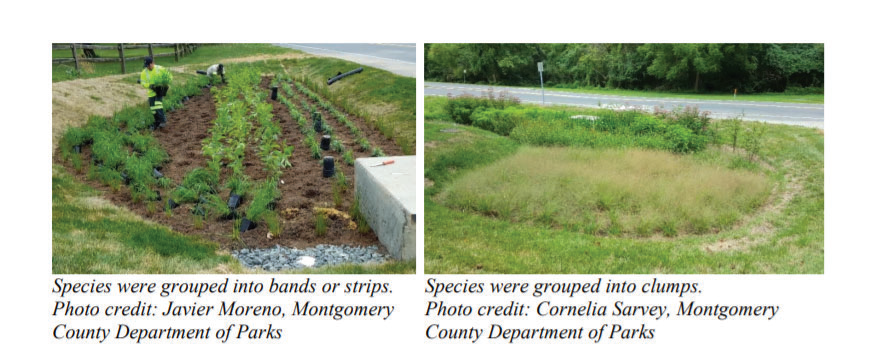
Examples of simple geometric layouts for plants to allow maintenance staff to easily distinguish weeds from desirable plants. Photos courtesy of Erin McArdle, Montgomery County Department of Parks. Reference: Vegetation in Stormwater BMPs, Maryland Department of Environment, November 2019 - Native plants are encouraged in stormwater facilities because of their “greater survivorship” and tendency to require “less replacement and maintenance.” Plants must be chosen that have a high chance of thriving in the particular facility type. The top 3-5 inches of soil must be loosened, and 4-8 inches of topsoil must be placed on top and not compacted.
- Designers should consider the type of plants that are not invasive.
- Inadequate maintenance is a frequent issue for many possible reasons, including limited resources, a lack of knowledge, or miscommunication regarding maintenance responsibility. The simplest way to minimize maintenance effort is to choose plants that are low maintenance. This includes species that require minimal trimming and fertilizer, and plants that are well matched to the climate. Plants that require little work are more likely to survive in the event of ownership transfers since their maintenance legacy is minimal.
- Fertilizers should not be applied to BMP vegetation during routine maintenance. Stormwater BMPs are designed to capture nutrients in runoff and therefore should not be a source of nitrogen or phosphorus. While a minimal amount of fertilizer may be necessary in some cases to initially establish vegetation, it should not be used during routine maintenance.
References
- Maryland Stormwater Design Manual , Volumes I and II
- Vegetation in Stormwater Best Management Practices, Maryland Department of Environment, November 2019