
By Maggie Trovato
Published: Baltimore Sun, January 23, 2026
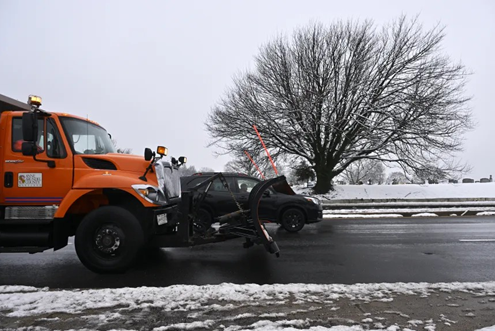
In the dead of summer, Anne Arundel County Road Operations Chief Jim Small is still thinking about snow.
“This is a year-round process,” said Small, who works for the countyʼs Department of Public Works.
When all the snow has melted away, the road operations crew discusses how it can improve its snow removal process, and it prepares contracts for next winter, Small said.
According to the Department of Public Works, the county spends, on average, $3.67 million annually on storm costs. This number includes the costs of salt, contractors and county personnel.
The money is used to clear 6,715 county roads, which stretch 1,850 center line miles in total, according to the county.
Small said the snow removal budget is designated for certainties - or things they know they will have to spend money on no matter. “For the unpredictable nature of the severe weather, we also have the ability to tap into the countyʼs contingency funds,” he said. “And this allows us to scale our response based on the actual severity of the winter without over-budgeting for a mild season.”
In the last 10 years, annual storm costs for the county have reached as high as $7.05 million and dipped as low as $333,111.
Small said his bureau is “very mindful” about ensuring that it doesnʼt overbudget for the certainties. He said the bureau runs its numbers every year.
According to the department, the county budgeted $300,000 for contractor retainers in fiscal year 2026. These retainers are agreements between the county and snowplow contractors.
Amy Mininger, a spokesperson for the Department of Public Works, said in an email that the county doesnʼt have a line item in the budget for salt because it uses and restocks salt based on annual needs. She said there also isnʼt a line in the budget for snow response related to employees because those workers are budgeted as full-time equivalent employees by their department.
Mininger said that after the storm is over, the county will total all of these costs, including overtime pay. She said this is the same process that the state uses to address snow removal.
Getting out on the road
As Small prepared Friday for what is expected to be the regionʼs first major snowstorm of the year, he said he planned to bring his staff in at about 8 p.m. Saturday, so they would be ready when the snow falls.
Small said that for a snow event, he has 350 employees, ranging from managers to plow operators to administrators. He said he also has 200 contractors on retainer.
Mininger said county teams are supplemented with “enough contract labor to nearly triple the workforce.”
“Though we prioritize tax-dollar savings by dismissing these crews once local roads are passable and consolidating our remaining efforts on high-priority commuter arteries,” she said.
The biggest concern residents have with Smallʼs department is when plows will reach their neighborhood or cul-de-sac.
Although the department historically focused on major roads first, its current strategy is “concurrent plowing,” where plows are simultaneously placed on every kind of road, from large roads known as “arterials” to small neighborhood streets known as “local roads.”
This means that while one truck might be plowing snow from Riva Road, another might be plowing a small cul-de-sac in Linthicum Heights.
Small said this helps ensure first responders can get where they need to go. He said the reason a truck might not get to a certain neighborhood street right away is that it takes time to get through an entire neighborhood.
On average, it takes his staff about two hours to complete the first circuit of their route during a big snow event, Small said.
“In the remainder of their 12-hour shift, they are constantly rotating through their assigned route,” he said.
“It doesnʼt matter where itʼs located in Anne Arundel County,” he said. “If itʼs an arterial, it gets treated like an arterial if itʼs in Glen Burnie or in South County.”
In a statement, Karen Henry, the countyʼs Public Works director, said the departmentʼs top priority in a snow event is the safety of residents and “swift restoration of essential services.”
Henry asked that residents move their parked vehicles off the street this weekend so plows can efficiently clear the roads. She said drivers who see a plow on the road should slow down, keep a distance and should not try to pass the plow.
“Also, remember to clear nearby sidewalks and fire hydrants, and be mindful not to pile snow over storm drains,” she said. “Finally, limiting non-essential travel keeps roads clear for emergency and removal crews.”
To learn more about the countyʼs snow removal process, visit aacounty.org/public-works/highways/snow-removal.
Small said residents can keep up with the Department of Public Works via its social media accounts. Residents can also visit the countyʼs snow removal tracker at https://citizeninsights.geotab.com/#/aacosnowremovalstatus
To report a snow-related concern, residents can call 311 or visit aacounty.org/contact/report-concern.