Update #01
The Anne Arundel County Department of Inspections and Permits (I&P) has previously published guidance on private roads for development projects in the form of IP-25-01, published 03/13/2025.
As a result of recommendations from the County Office of Law, and further discussions between the Department of Inspections and Permits(I&P), Office of Planning and Zoning and the Fire Marshall’s Office, I&P is providing Update #01 to the 03/13/2025 guidance.
As noted in the IP-25-01 notice, minimum requirements related to roads and drive aisles can be found within the Anne Arundel County Code and the National Fire Protection Association (NFPA) standards. The design professional shall ensure that proposed roads provide sufficient access and width for fire safety apparatus, fire department response efficiency and for general public and emergency personnel safety. A 24-foot width minimum is the standard for two-way traffic roadways in NFPA 1141.
Please see below summary for this update and as noted on the attachments.
- Underlined text indicates new matter added.
Strikethrough textindicates matter deleted. - Added alley definition.
- Added language to clarify that an alley shall not be used to directly access private garages or driveways in the front or rear.
- Removed Private Alley Detail
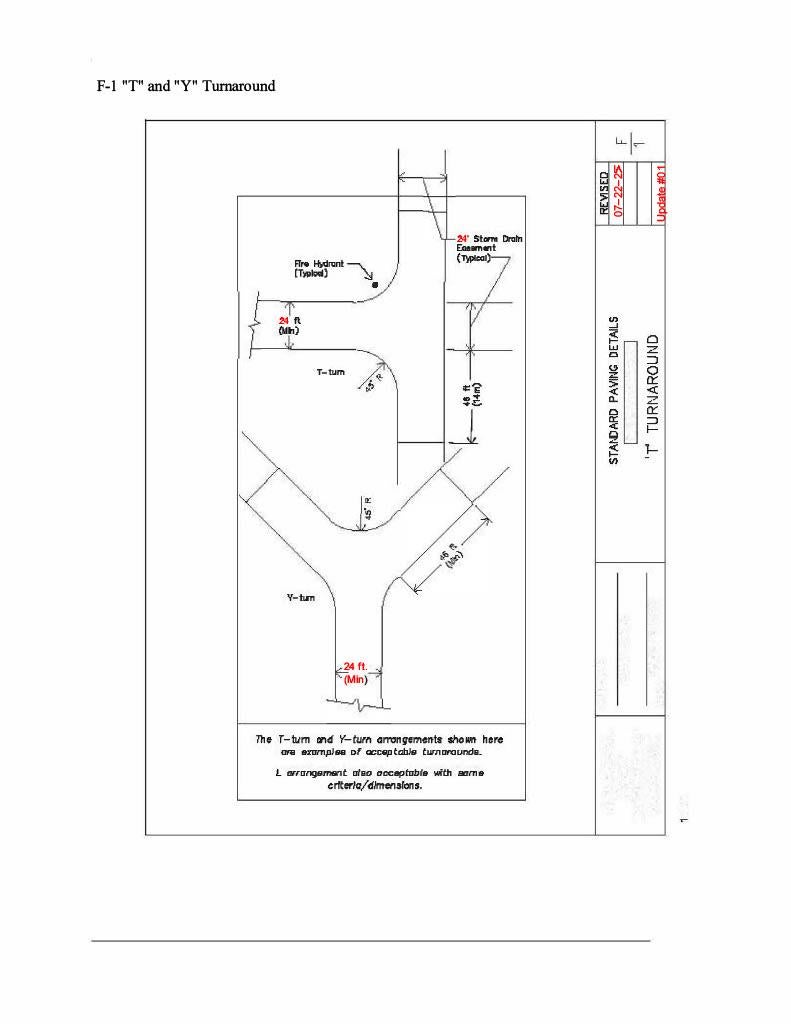
- Updated pavement width on detail F/1 as “24-ft (Min)”
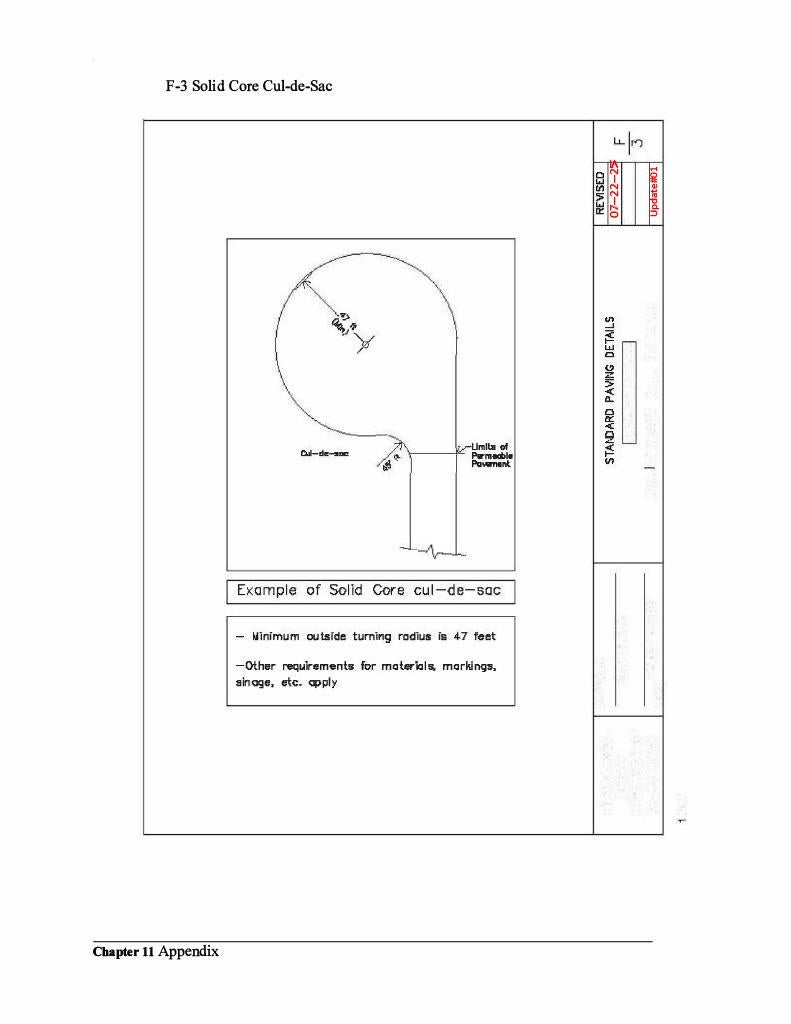
- Removed references to public and Department of Public Works approval on detail F/1 and F/3
- Removed Detail F/2 (Hollow Core Culdesac)
This guidance was published as IP-25-01 notice and the notice is being updated (update #01) as noted above and published for a 30-day comment period.
Background
Several minimum requirements related to roads and drive aisles can be found within the Anne Arundel County Code, the National Fire Protection Association (NFPA) standards, the Department of Public Work Design Manual (DPW DM), amongst other regulatory requirements that are adopted by the County code. On July 31, 2020, DPW published Orange Notice DPW 20-03 for the purpose of updating the Road CrossSection requirements. Effective August 24, 2020, the updated standards replaced the Standard Details P-1 through P-9 in Section 6 of the “Standard Details for Construction” of the DPW DM. DPW noted that these requirements do not apply to private roads and that the Department of Inspections & Permits (I&P) will publish separate guidance for those facilities. The intention of separating the requirements for public and private roads was to establish I&P versus DPW as the agency responsible for making final technical determinations in reviewing exceptions to the standards pertaining to privately owned and maintained facilities.
Purpose
County Code § 18-1-101 defines road as “Road means an open way that is dedicated as a public or private right- of-way or easement for the passage of vehicles and persons.” The purpose of this notice is to publish general design standards that specifically apply to privately owned and maintained infrastructure including roads, alleys, drive aisles, and common use access easement. A sample private road standard exhibits and section views are included at the end of this memo to facilitate the interpretation of standards for private roads. It is noted that while this memo establishes some minimum design standards for private road design, it does not cover each and every design scenario that may be encountered with development projects. This office expects the design professional to provide private road designs that follow good engineering practices to meet public safety and welfare standards. Representatives of DPW, Office of Planning and Zoning (OPZ), I&P, and the Fire Marshal’s office have met to identify minimum road design standards to be used in the design and review of private roads in the County.
This memo is intended to provide guidance for designing private roads that are not subject to the DPW DM. Therefore, modifications to the Design Manual are not necessary for private roads.
Scope – Private Roads
The standards in this memo do not extend to residential, commercial/industrial entrances from a public road, which are governed by the DPW DM (Chapter III, sections H and I, as updated), amongst other regulatory requirements. Per §17-6-103 (i)(2) of the County code, generally, roads within and serving commercial, industrial, or multifamily residential development shall be privately owned. This guidance also applies to other residential developments e.g., townhouses, stacked townhouses or other project types, that are served by private roads, and the DPW DM does not apply. Drive aisles are generally designed similar to parking lots; width of drive aisles shall meet County Code § 17-6-603. When a private road intersects with a public road, criteria related to such intersections shall be designed in accordance with DPW DM. Proposed development shall provide for the proper arrangement of roads in relation to those existing or planned and to provide for the most beneficial relationship between the use of land, buildings, traffic, and pedestrian movements.
Minimum Design Criteria
Design Speeds
The design speeds for private roads, designed to the minimum criteria noted in this memo, are based on a minimum 10 miles per hour for alley-ways, and minimum 15 mph for private roads and through alley-ways. These design speeds must be posted as such. Regarding vertical curvature design, the minimum K- factor shall be 10 for crests and sags for alley-ways and the minimum K-factor shall be 15 for crests and 20 for sags for private roads. It shall be noted that Private Roads – Guidance For Development Projects - December 30, 2024 the number of lanes and design of the road shall be determined based on the traffic analysis submitted.
Pavement Width
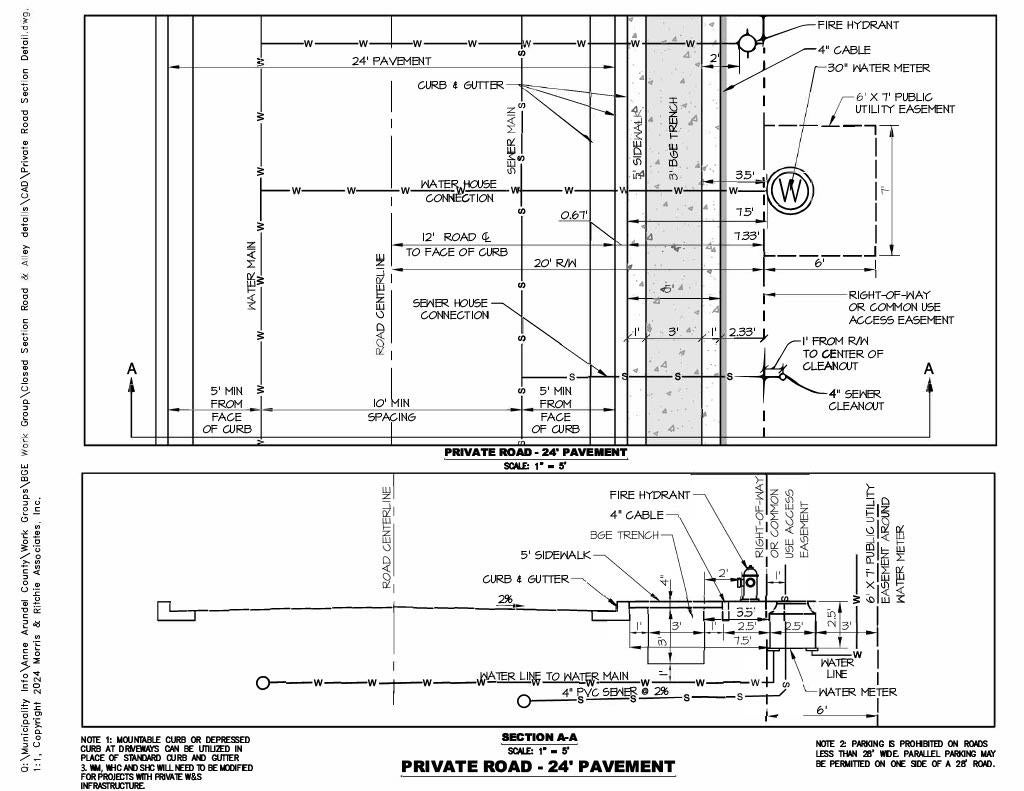
Clear travel width for two-way private roads shall be a minimum of 24 ft (flow line face of curb to flow line face of curb). The design professional shall ensure that all proposed roads provide sufficient access and width for: fire safety apparatus; fire department response efficiency; and for general public and employee safety. A 24-foot width minimum is the standard for two-way traffic roadways in NFPA 1141. Alleys shall be a minimum of 20 ft (flow line face of curb to flow line face of curb). Alley is a trafficway, which provides secondary service access for vehicles and pedestrians to the side of abutting properties. Alleys, when proposed, may only be used as direct, straight throughways to connect full width roadways. Alleys shall not be used to directly access private garages, or driveways, or the front or rear of the property/structure/building/unit. Narrower travel lanes (not less than 10 feet/lane) may be permitted if the total pavement width complies with the requirements in the parking section below. Alley-ways shall be a minimum of 20 ft (face of curb to face of curb).
Parking
The Anne Arundel County Fire Marshal imposes parking restrictions to ensure adequate operational access. On-street parking prohibitions shall be implemented via signs and pavement markings. No on-street parallel parking is permitted when the pavement’s width is less than 28 feet. One-side parallel parking is permitted when the pavement’s width is between 28 and 35 feet. Two-sided parallel parking is permitted with a pavement width equal to or exceeding 36 feet. For all pavement widths referenced in this guidance, the pavement width measurement may include the gutter pans. One-way drive aisles shall be no less than 15' for angled parking and 20' for perpendicular parking The approved County “No parking signs” are furnished by the developer, maintained by the HOA, and enforced by the Anne Arundel County Police Department. The developer shall ensure that these requirements are a part of the Declaration of Covenants for the owner and/or legal entity responsible for the private roads and alley-ways (i.e., HOA, condo association, etc.).
- Fire Hydrants must be accessible through a 15’ wide strip that does not contain parking (to ensure accessibility)
- No parking within 30 feet of a stop sign
- No parking within 20 feet of a crosswalk in an intersection
- No parking in an intersection
- No parking on a sidewalk or planting strip
- No parking in front of driveways or parking spaces
- No parking in a dedicated vehicle turnaround
- On-street perpendicular parking is allowed on private roads and must conform to the requirements in Article 17, Title 6, Subtitle 6 of the County Code for parking space size.
Sight Distance
Private road design must conform to AASHTO’s Green Book sight distance requirements related to stopping and intersection sight distance. Driveway placement shall be reviewed by the design engineer and designs should demonstrate (based on the design speed) that sufficient stopping distance is available for all vehicles to avoid collision with cars backing out of parking spaces or driveways. Generally, driveways may not be placed within 20 feet of the Point of Curvature (PC) of the curb. The designer may use these options to demonstrate adequate sight distance, which include, but are not limited to, turning radius templates, the use of sight distance equations, and field procedures found in AASHTO’s Private Roads – Guidance For Development Projects - December 30, 2024 Green Book. Under no circumstances, may any part of a driveway be constructed within the curb fillet radius, or be less than 20’ from the face of curb alignment of the intersecting road.
Intersection Spacing
Where multiple parallel alleys or private roads, internal to a proposed development, intersect with the same road, a 75-ft minimum intersection spacing (along this road) from Centerline to Centerline would be required. The roads, being intersected by alleys or private roads, are generally anticipated to experience low traffic volumes.
Fire Department Turnarounds “T”, “Y”, and “Cul-de-sac”
Dead-end private roadways greater than 150 feet in length require an approved turnaround. Turnarounds must be designed per the most updated version of Anne Arundel County's DPW DM. Currently, these standards reside in the Practices and Procedures Manual Standard Detail F1 and F3 (attached). No parking is permitted in cul-de-sacs. No parking signs must be clearly depicted on the private road plans. Written approval from the Fire Marshal is required before utilizing the hollow Cul-de-sac detail F2 in the Manual.
Adequate Pedestrian and Bicycle Facilities
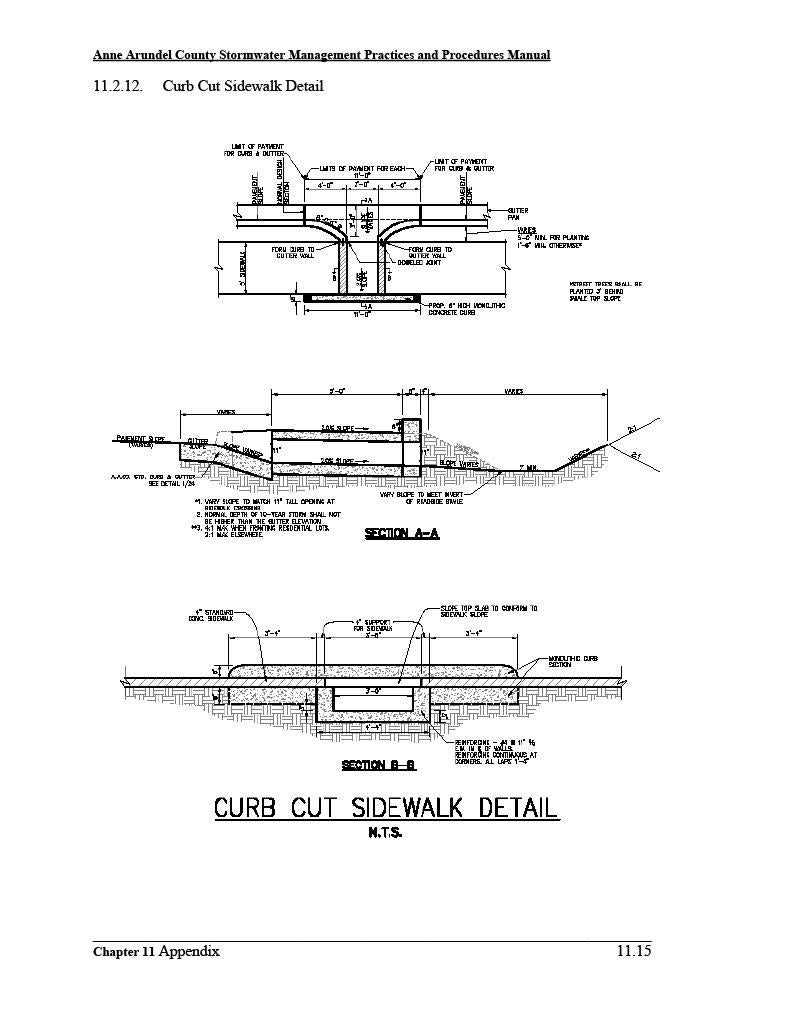
Adequate pedestrian facilities must be provided. An ADA compliant internal pedestrian network must be provided, including accessible pathways throughout the development and from all areas of the development to public pedestrian facilities and HOA facilities such as parks, pools, play areas, etc. The Applicant must provide pedestrian facilities that mimic the development's natural pedestrian path/tendencies and will be reviewed on a case-by-case basis. Pre-design meetings with OPZ Transportation will be facilitated to determine the appropriate pedestrian facilities on a project-by-project basis. In general, private roads, alleys, and drive aisles would not require Bicycle facilities. Where appropriate, Bicycle facilities may be required as deemed applicable from the section of the County Code identified below.
§ 17-7-201. Site development for commercial and industrial. (b) Linkages. Convenient functional linkages shall be achieved in commercial and industrial development by providing vehicular, bicycle, and pedestrian connections to promote the circulation and flow of vehicles, bicycles, and pedestrians between the development and existing uses.
ADA Standards
Per Maryland State law COMAR 09.12.53, the design for private roads must conform to the National accessibility standards, including the Anne Arundel County DPW DM’s latest published ADA standards.
Signage
Per Maryland State law - MD Transportation Code § 25-104 (2013), all private roads open to the public must adhere to the latest National Manual on Uniform Traffic Control Devices “MUTCD” standards. Below are excerpts from the 2011 Maryland MUTCD.
The MUTCD is the national standard for all traffic control devices installed on any street, highway, bikeway, or private road open to public travel (see definition in Section 1A.13). When a State or other Federal agency manual or supplement is required, that manual or supplement shall be in substantial conformance with the National MUTCD. Code of Federal Regulations CFR 655.603 also states that traffic control devices on all streets, highways, bikeways, and private roads open to public travel in each State shall be in substantial conformance with standards issued or endorsed by the Federal Highway Administration (FHA).
Pavement Surfaces, Construction Other Requirements
Where public infrastructure (e.g., water and sewer) is proposed, and to accommodate solid waste collection, and other public service and operational needs, the pavement design and construction of private roads shall meet the minimum requirements in the DPW DM, standard details, and specifications and shall support a 40 Ton minimum weight. The pavement structures require a minimum subgrade CBR of 5. If the soils on the project site do not satisfy the minimum CBR value, the design professional shall create a design that corrects the deficient sub base conditions. For all other private infrastructure facilities, a qualified professional (e.g., Geotechnical, structural engineer) recommendation shall be followed regarding construction standards and specification, pavement section, and support of the vehicular traffic. Commercial and Industrial facilities may need additional geotechnical analysis to support the selection of the pavement design. Maximum grades for fire lanes on paved surfaces are as follows:
- Concrete surfaces - 15%
- Asphalt surfaces - 12%
Grades shall not exceed 10% with a maximum grade of 4% for a minimum distance of 40 feet from its intersection with a public right-of-way. The alignment for private roads shall be in accordance with this guidance. The high and low elevation points of the road shall be clearly shown and labeled on the profile. Horizontal and vertical alignments cannot be designed independently as they complement each other. Curvature and grades must be in proper balance. Horizontal curvature should not be introduced at or near the top of a vertical curve. This condition is hazardous in that the driver cannot perceive the horizontal change in alignment, especially at night when the headlight beams go straight ahead into space. The hazard of this arrangement is avoided if the horizontal curvature leads the vertical curvature.
Private roads that intersect with existing or proposed private roads or public rights-of-way should intersect at a 90-degree angle, where possible. Where constrained by environmental features, a reduced angle of intersection may be used, but the angle shall never be less than 70degrees. Proposed private roads shall align directly across from, or be offset using the minimum intersection distance noted in this guidance.
Public Utilities
Cleanouts for sewer service connections shall be located one foot outside the proposed Public Utility Easements (PUE) and on private property. Small water meters shall be located within the mainline PUE, while large meters must be located within a dedicated PUE outside the mainline PUE on private properties. Cleanouts and meters shall, to the extent possible, be located outside of high traffic-bearing areas such as roads, sidewalks, paths, and driveways and at the inside edge of the PUE. The PUE width shall adhere to the latest version of the DPW DM and may not necessarily need to match the private road right-of-way width or common use access easement width. See details in this guidance for placement of water meters, cleanouts, and dry utilities. The PUE may need to be extended at the hydrant's location to allow at least 3 feet from the exterior edge of the hydrant to allow DPW to maintain and replace the hydrant as needed. DPW standard details W-1 and S-1 are required for the construction and repair of trenches for all utilities within the pavement section of private roads.
Declaration
See County code § 17-6-103 (j)- Private roads; declaration.
Exceptions
If the design professional for any reason finds it necessary to use procedures, standards or criteria other than those included in this memo, he/she must apply to the County for an exception. Three copies of any request for an exception are to be addressed to the Assistant Director, Inspections and Permits. After review of the exception requests, the Department will issue a decision to the applicant/developer.
The following information at a minimum will be addressed in the request:
- Identify Hardship (should not include hardships resulting from actions of applicant or the property owner);
- Reason for the exception;
- Description of Proposed Alternative(s);
- How does the alternative proposal provide an equivalent or superior level of quality, strength, effectiveness, durability, maintainability, and protection of public health, safety, and welfare as is required in this memo, county code or other regulatory standards;
- The request is not detrimental to the public health, safety, or welfare, is not injurious to other properties; and
- The narrative and justification may be accompanied by drawings, photographs, catalog cuts or publications which the design professional deems necessary or desirable to support his/her position.
Timing
Any application for sketch plan, preliminary plan submitted to the County on or after Sep 09, 2025 shall meet these standards. Final Plans and Site Development Plan which received Sketch plan and preliminary plan approvals may continue to use standards approved with those plans. This is an update to published guidance (dated 03/13/25) and projects accepted for review on/after March 13, 2025 shall need to work with individual review agencies for compliance with all applicable fire and public safety, welfare regulations and standards. Any projects that received modification approval to skip sketch or preliminary plan after Sep 09, 2025 shall meet these standards. Any application for sketch plan, preliminary plan, Final plan or Site Development plans submitted to the County on or after the date of this notice should meet these standards. Final Plans and Site Development Plan which received Sketch plan and preliminary plan approvals may continue to use standards approved with those plans. Application date is the date the permit center receives the application. Projects accepted for review or already under review or received sketch, preliminary plan approval prior to the date of this memo may not need to meet these standards. Any projects that received modification approval to skip sketch or preliminary plan after the date of this notice should meet these standards. Projects that submitted for special exception or received approval shall design roads to meet these standards as a part of the Subdivision or site development plan projects.